From the Trenches of AI — Vol. 10
True leadership has never been about moving first. It has been about moving wisely — understanding the tools at your disposal, the people in your care, and the consequences of the decisions you make before you make them. History’s most enduring leaders — in business, in battle, in civic life — are remembered not for the speed of their decisions but for the quality of their judgment.
Which makes what happened in corporate America between 2023 and 2026 one of the more instructive leadership failures of the modern era.
AI had arrived. Headcount was overhead. The math looked simple: replace people with AI, cut costs, impress shareholders, and ride the efficiency wave into the future. Tens of thousands of engineers, customer service agents, analysts, coordinators, and managers were laid off. Press releases cited AI productivity gains. Stock prices ticked up. CEOs congratulated themselves on their boldness.
Then the work didn’t get done.
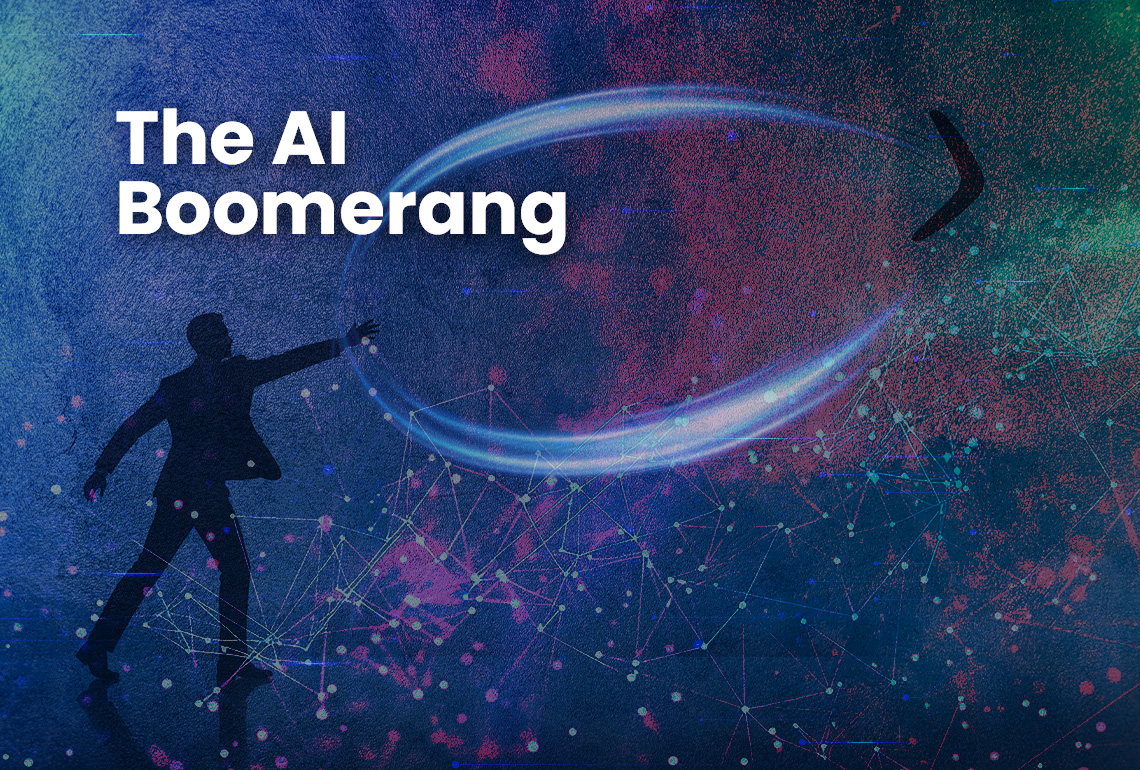
Now, quietly and with considerably less fanfare than the layoffs that preceded it, those same companies are hiring again — often for the exact same roles, sometimes at higher salaries than before, frequently reaching back out to the very people they let go. Industry analysts have given it a name: the AI boomerang. And the data behind it should reshape how every business leader thinks about what AI actually is — and what true leadership in the age of AI actually requires.
The numbers are not small
This is not a handful of anecdotal reversals. The boomerang is a documented, measurable trend — and it is accelerating.
A study by Robert Half, one of the world’s leading talent solutions firms, found that more than 3 in 10 U.S. hiring managers who eliminated positions after their organization implemented AI later had to add those roles, or very similar ones, back.
Gartner predicts that 50% of all companies that replaced customer service or operational employees with AI will be forced to restaff those roles under different titles by next year.
Half a billion dollars in severance packages. Half the decisions reversed. That is not a market correction. That is a leadership failure at scale — one born not from malice, but from the most dangerous kind of confidence: confidence in a tool you do not fully understand, deployed against a problem you have not fully defined.
And underneath all of it, a misunderstanding of something fundamental: AI cannot replace judgment. It can inform it, accelerate it, and sharpen it — but the judgment itself must remain human. The moment a company treats AI as a substitute for human judgment rather than a multiplier of it, the boomerang is already in the air.
The case studies are instructive
Ford Motor Company
Ford invested heavily in automated quality control systems designed to catch design flaws and manufacturing defects. The AI couldn’t do it. Without decades of engineering judgment encoded in training data, Ford’s automated tools amplified weak inputs rather than catching problems. The company ultimately rehired 350 veteran engineers, including retirees. These engineers now lead new-hire training, oversee design reviews, and are even tasked with improving the AI tools themselves.
“AI is a great tool, but it only works as well as the information it’s been trained on. We misjudged — we thought we could just implement AI, input the requirements, and high-quality products would come out.” — Charles Poon, VP of Hardware Engineering, Ford
Ford’s decision to rehire is directly attributed to its leading JD Power’s 2026 Initial Quality Study rankings for the first time in 16 years. The engineers didn’t just fill a gap. They reversed a decline. That is the difference between a tool and the judgment required to use it well.
IBM
IBM replaced large parts of its HR function with AI, then began rehiring when the system couldn’t handle anything that required empathy or subjective judgment. IBM’s AI-powered AskHR platform now automates 94% of routine HR inquiries — but the remaining cases, those requiring judgment and context, still depend on human employees. IBM CEO Arvind Krishna has said that AI-driven productivity gains are now allowing the company to expand hiring in software engineering, sales, and customer-facing roles — rather than simply shrinking its workforce. IBM did not abandon AI. It found the line between what AI does well and what humans do better — and staffed accordingly. That is the model.
Klarna
In 2024, Klarna celebrated an AI agent handling the workload of 700 people. The technology worked fine — it handled the volume, cut costs, and moved faster than any human team could. What failed was the brand experience. Klarna is now rehiring human agents for fully remote roles. The company has shifted to a hybrid model where AI handles routine, high-volume queries and people handle everything that requires judgment. The CEO who once wanted to eliminate 700 positions now calls quality human support “the way of the future.” Volume is not quality. And in an industry where customers feel a problem personally, that distinction is everything.
McDonald’s
For a moment of levity: McDonald’s shut down its AI drive-thru test after viral videos exposed the system adding hundreds of dollars worth of Chicken McNuggets to simple orders — and brought human cashiers back to run the lanes. The customer had asked for a 10-piece. The AI had other ideas. Someone in leadership approved that deployment without fully understanding what the tool could and could not do in a live environment. The McNuggets were the result.
The common thread
Writing in Inc., B2B marketing consultant and AI strategist Pam Didner offered perhaps the most practical diagnosis of why these reversals keep happening: the companies now rushing to rehire didn’t necessarily undervalue experience — they took a shortcut. They cut without ever mapping where judgment actually lived. They paid to be wrong, and then they paid again to undo it. Her prescription is direct: walk one process end to end and at each step, note what triggers the next action, who performs it, and what judgment it takes to move on. The AI-human line isn’t a policy you set from above — it’s already being drawn, one workflow at a time, by the people doing the work.
The company that got it right
In the middle of all this wreckage, one story stands out — not just as a business success, but as a model of what genuine leadership in the AI age looks like.
When IKEA deployed its AI chatbot Billie — which resolved 47% of customer inquiries and handled roughly 3.2 million interactions, producing nearly €13 million in operating savings — the company faced the same inflection point that Ford, IBM, and Klarna all faced. Half the workload was now handled by AI. The obvious move was to cut half the headcount.
IKEA’s leadership asked a different question. Not “how many people can we cut?” but “what could these people do that the chatbot never can?”
That is the question of a leader who understands their tool — who knows precisely where AI ends and where human judgment begins, and who refuses to confuse the two.
The answer was interior design. They retrained all 8,500 employees to offer premium design services. The new channel accounted for €1.3 billion in revenue in 2024 — 3.3% of total revenue — and is projected to grow to 10% by 2028.
A traditional call center is a cost to be minimized. IKEA converted it into a revenue-generating consultancy — which is a fundamentally different thing to own on a balance sheet.
AI handled what AI does well. Humans were freed to do what humans do better. The result was not cost reduction — it was growth. That is AI as a productivity multiplier, not a people replacer. And it was made possible entirely by the quality of the leadership decision that preceded it.
What true leadership in the AI age looks like
The boomerang is not fundamentally a story about AI. It is a story about leadership — specifically, about what happens when leaders abdicate the responsibility to understand their tools before deploying them at scale against the people who depend on them.
True leadership in the age of AI means asking hard questions before the press release is written:
- What does this tool actually do — and what does it not do?
- Where are the genuine business use cases where AI creates measurable value — and where does my workforce bring something AI simply cannot replicate?
- What judgment lives in the people we are considering removing that cannot be transferred to a model?
- What happens to our customers, our quality, and our institutional memory if we are wrong?
- What does success actually look like twelve months from now — not in a demo, not in a CFO presentation, but in the daily reality of the people doing the work?
These are not the questions of a cautious leader or a reluctant adopter. They are the questions of a serious one.
Let us be clear: we are not advocating for slowing down AI adoption. We are advocating for doing it right. The companies that are winning with AI are not the ones that moved fastest. They are the ones that moved most deliberately — mapping their real business use cases, understanding where AI creates genuine leverage, and then asking honestly where their people bring something no model can match. That intersection — where AI capability meets human judgment — is where the real value lives.
At EDC®, one of our founding principles — one that predates the current AI moment and has guided how we built MERCED™ — is this: AI is a productivity enhancer, not a people replacer. And AI cannot replace judgment. It can surface information faster, automate the repetitive, and sharpen the analysis — but the judgment call, the contextual wisdom, the decision that accounts for what the data cannot see, belongs to the human being in the room.
The leaders who understood that before acting are not scrambling to rehire. They are accelerating — because their people are now more capable, more focused, and more empowered than they were before AI arrived. That is the promise AI was always meant to deliver. Not a smaller workforce. A better one.
The boomerang is the market’s way of correcting the leaders who missed that distinction. We intend to keep helping our industry see it clearly — from the trenches.
“From the Trenches of AI” is an ongoing EDC® LinkedIn series exploring artificial intelligence through the lens of an industry that moves people, not just data.
About the Author
Diana Corona
Co-Founder, President & CEO — Enterprise Database Corporation (EDC®)
Diana Corona co-founded EDC® over 25 years ago and has spent her career building software purpose-built for the moving and storage industry. Under her leadership, EDC® has grown into one of the most trusted technology partners in the space — serving moving companies of all sizes across residential, commercial, military, government, international, and specialty move types. She writes on topics at the intersection of technology, operations, and the future of the moving industry.